
Paint an elephant you have never seen
You are a monk in thirteenth-century England, trained in the painting of manuscripts, and your abbot has handed you a job. He is making a bestiary, a book of beasts, and you are to paint the elephant.
You have never seen an elephant. No one you have ever met has seen one. The last elephant to stand on English ground arrived with a Roman army more than a thousand years before you were born. What you have is a description in a Latin book, copied from an older book, copied in its turn from older books still, running back through the Roman encyclopaedist Pliny to a strange little Christian animal-manual out of Alexandria. The description tells you a few firm things. The elephant is the largest of all beasts. It has no joints in its knees. It sleeps leaning against a tree, because if it lay down it could never rise. It is terrified of mice. It carries castles full of soldiers on its back into battle. Its mortal enemy is the dragon.
Now paint that.
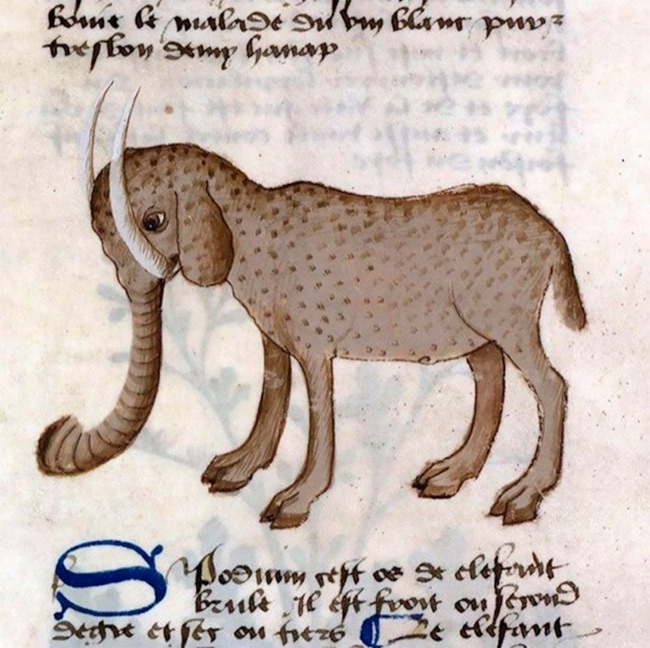
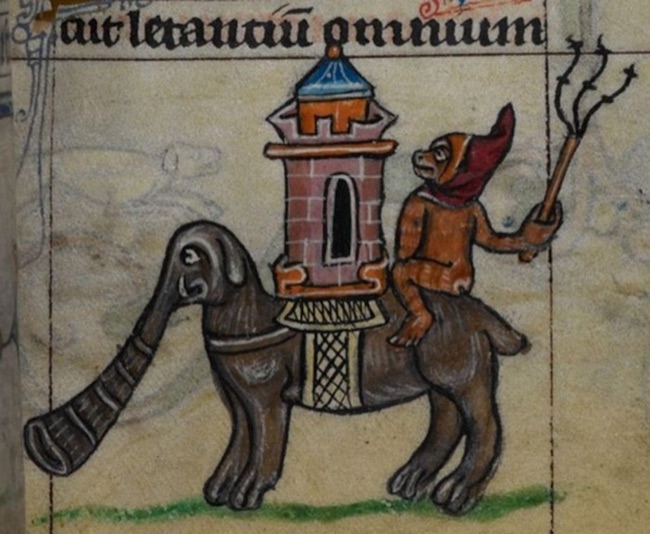
What comes out of your brush has hooves, because every large four-legged animal you have ever seen, the horse, the ox, the cow, has hooves, and your hand knows no other way to end a heavy leg. The trunk comes out like a trumpet, a tapering brass tube, because a long thing that sticks out of a face and makes a loud noise can only be the nearest long noise-making thing you know. The castle on its back is a proper castle, stone, with crenellations along the top, because that is what a castle is in your world. And the finished elephant is perfect. It is recognisable, instantly, to every other person who has read the same books. It is also completely unrecognisable to anyone who has ever stood next to the actual animal.
This piece is about why, and the answer turns out to reach a long way past medieval monks.
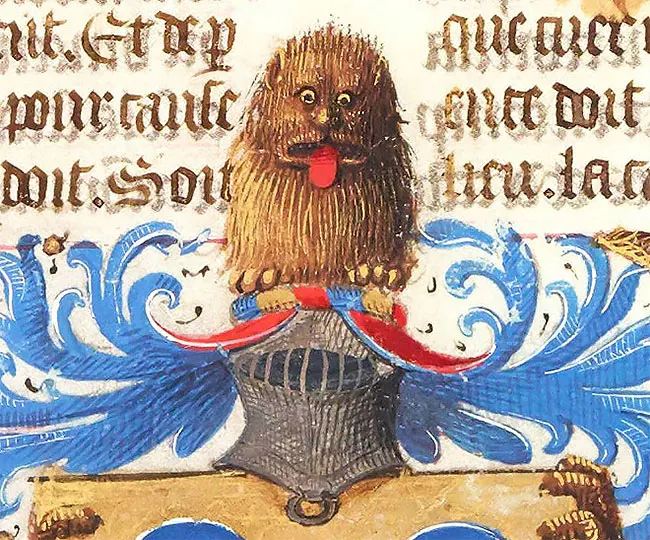
The easy explanation is the one everyone reaches for first: ignorance. The artists had no access to the real thing and did their honest best with a description. That is true, and it explains almost nothing, because the same artists drew animals they saw every single day just as wrongly. They drew snails with the ears and teeth of cats. They drew rabbits, ordinary rabbits, turning on armoured knights and running them through. They drew dogs with disturbingly human faces. These were not animals at a thousand years' distance. They were in the yard. The wrongness had nothing to do with how far the animal was from the painter. Something else was running the brush.
The wrongness had nothing to do with how far the animal was from the painter.
That something is the subject here, and it is not a flaw of the medieval mind. It is what any way of seeing does when it meets a thing its categories are not built to hold. It does not stop, or stammer, or admit the gap. It carries on, fluently, confidently, in elaborate detail, in the wrong language. And the wrongness is not random. It follows, with great precision, the grammar of the pictures the painter already has, rather than the shape of the thing in front of him.
It carries on, fluently, confidently, in elaborate detail, in the wrong language.
The word before the thing
To see how the grammar got so strong, follow where the elephant in the book came from, because it did not come from an elephant.
It began with a small book called the Physiologus, written by someone whose name is lost, in Alexandria, around the second century. It is not a nature book in any sense we would recognise. Every entry has the same three parts: a few words on what the animal looks like, a claim about something it does, and then the real payload, a Christian lesson the behaviour is made to teach. Take the lion. The Physiologus tells you that the lion sweeps away its own tracks with its tail as it walks, which is how Christ concealed his divinity; that the lion sleeps with its eyes open, which is Christ dead on the cross and alive in spirit; that lion cubs are born dead and lie lifeless for three days until the father breathes over them and wakes them, which is the resurrection. The lion is not being described. The lion is a hook to hang a sermon on, an animal that happens to have legs. Accuracy was never the point, because the book was never about animals. It was about God, and the animal was the delivery van.
It was about God, and the animal was the delivery van.
Onto this was layered the authority of Pliny, the Roman whose vast encyclopaedia was treated as simply true for over a thousand years. The knees that do not bend, the sleeping against trees, the fear of mice, all of it is Pliny, and what made it stick was not that anyone checked it but that Pliny had said it. This is the part a modern reader is quickest to sneer at and slowest to understand. It was not mere gullibility. It was a different idea of where knowledge lives. Knowledge lived in the text. What was true was what the authorities had written, and a thing you saw with your own eyes had a hard time outranking a thing Pliny had set down in ink.
Then came the move that gives the whole game away, made by Isidore of Seville around the year 630, the encyclopaedist whose vast compilation of all knowledge was a standard reference across Europe for the next thousand years, who built it by working out the natures of things from the origins of their names. The lion, leo, he traced back through Greek to the word for king, and concluded from the word that the lion is the king of beasts. The nature of the animal is deduced from the spelling of its name. The word comes first, and the thing is made to follow. The name does not label a category that already exists in the world; the name calls the category into being. And every painter downstream of Isidore was, without knowing it, doing the same thing he did out loud. The description in the book was not a record of the animal. It was an act that constituted the animal, inside the tradition, out of older words.
The name does not label a category that already exists in the world; the name calls the category into being. The word comes first, and the thing is made to follow.
So by the time our monk dips his brush, the thing he is painting is no longer a creature at all. It is a thousand years of text folded over on itself, each copy a little further from anything that ever breathed, each layer adding more sermon and more authority and less animal. The living elephant has become, in its own book, the one thing that is not allowed in: the referent that the whole apparatus was built to describe and has quietly shut out.
The living elephant has become, in its own book, the one thing that is not allowed in: the referent that the whole apparatus was built to describe and has quietly shut out.
The grammar speaks
The wrongness is not slapdash. It is rule-governed, and the rules are the rules of the pictures the painter has, not the anatomy of the beast. Three things are happening, and they come apart cleanly, one at a time.
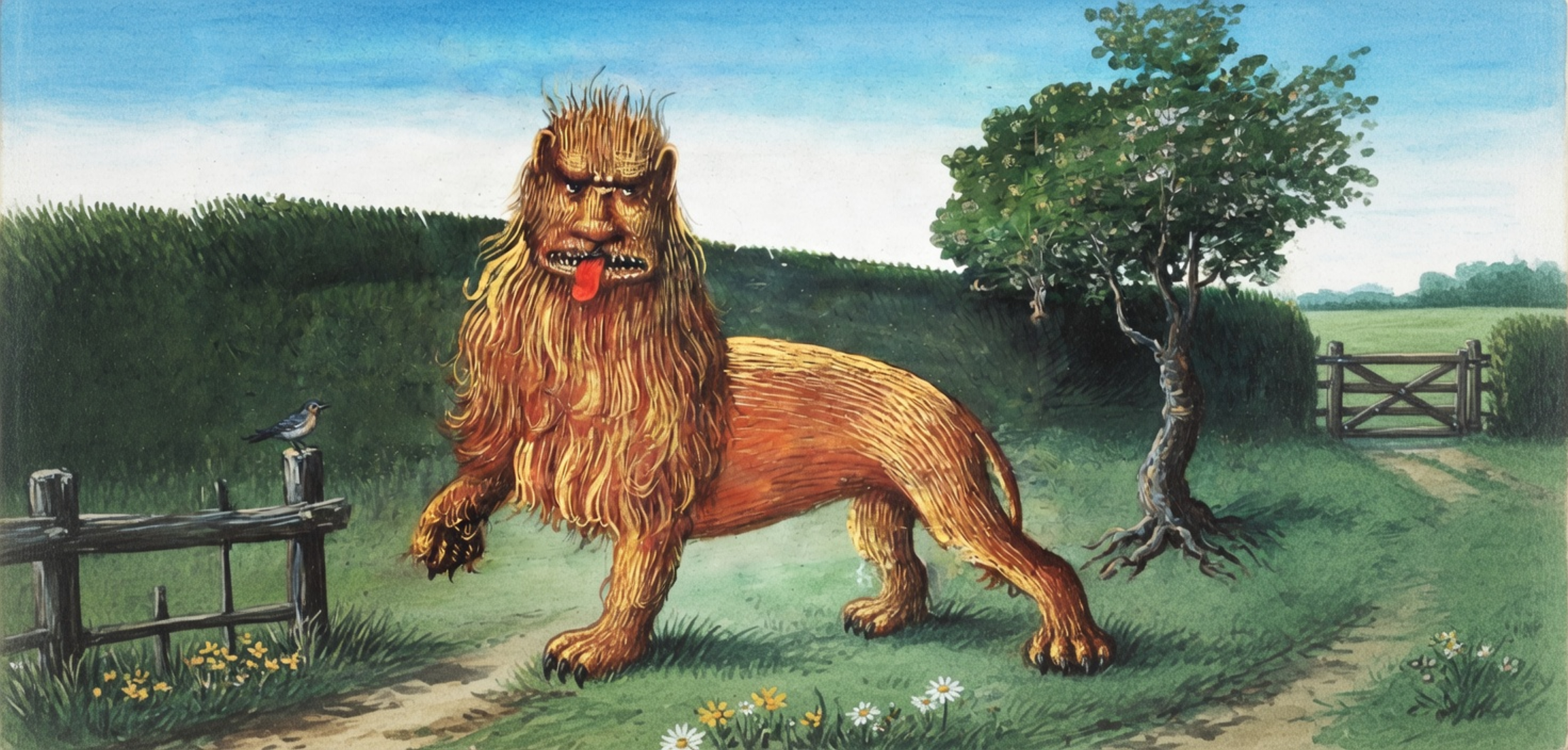
The first is the simplest and the most revealing. The lion, across the whole tradition, has a more or less human face. Not because anyone thought lions looked like people, but because the painter's stock of pictures contains no way to draw a face that is noble, or fierce, or intelligent, that is not a human face. The category "lion" exists; he knows the word, he can tell the lion entry from the leopard entry. What he does not have is any means of letting a lion's face be a lion's face on its own terms. The nearest available picture for an expressive face is the human one, so that is what the lion gets. The same machinery runs the whole menagerie. The crocodile, described in one book as shaped "rather like an ox," ends up with long mammalian legs and a bovine body. The beaver, filed as a water-creature so that monks could eat it on fast days, is given a fish's tail to match its category. The whale is drawn as an enormous fish with the face of a lion, one schema for the sea and another for the fearsome, stitched together. In every case the distortion traces the outline of the available pictures, never the outline of the animal. The elephant is the clearest of all: lay its hooves and its trumpet and its stone castle side by side and you are not looking at a bad drawing of an elephant. You are looking at a precise map of every category the painter had to work with. It is the grammar of his picture-world, rendered as anatomy.
It is the grammar of his picture-world, rendered as anatomy.
In every case the distortion traces the outline of the available pictures, never the outline of the animal.
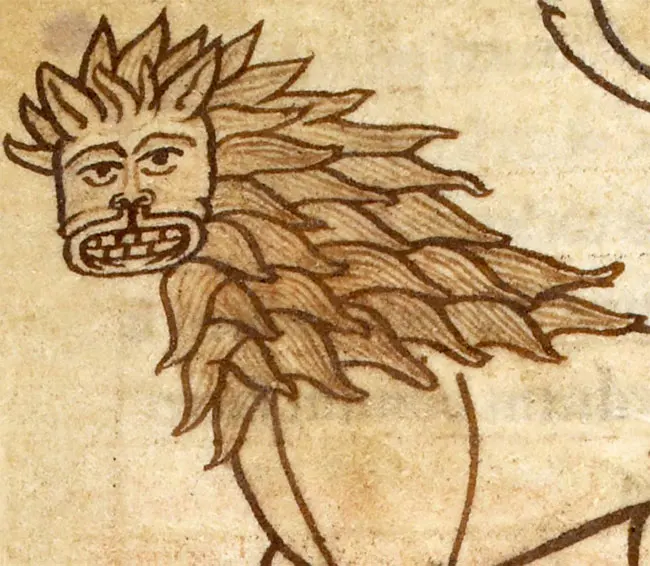
The second thing is how the wrongness spreads, and it does not spread the way you would guess. It does not spread from the animal. It spreads from earlier drawings. Take the lions of the British manuscript tradition and they all share the same mane, the same set of the face, the same way of standing, because each one was traced from an older lion, which had been traced from an older lion, back and back, none of them ever passing within sight of a real one. And the trap is this, because it looks like a game of broken telephone, a message getting garbled as it is whispered down a line. It is the opposite. The copies were faithful. What was being faithfully handed down, with great care and high fidelity, was the schema itself. The thing that reproduced cleanly was the picture; the only thing that drifted was the animal it was supposed to be of. And the two are the same event seen from opposite ends: every faithful copy makes the "bestiary lion" a little more settled, more canonical, more obviously correct, and by exactly that much makes the real lion a little less real as a thing the drawing answers to. The better the tradition got at reproducing itself, the more completely it buried the creature. It did not improve with the centuries. It got worse, more confident and more wrong together, because confidence and wrongness were being produced by the same machine.
It got worse, more confident and more wrong together, because confidence and wrongness were being produced by the same machine. The thing that reproduced cleanly was the picture; the only thing that drifted was the animal it was supposed to be of.
The third thing is where the comfortable explanation dies. If the problem were only ignorance, then access would cure it: show the painter a real elephant and the drawing comes right. It does not. In 1255 the King of France sent the King of England an African elephant, the first the country had seen since the Romans, and it was kept at the Tower of London, ten feet of it, fed on beef and red wine by a keeper named Henri de Flor. Matthew Paris, one of the great chroniclers of the medieval world, went to the Tower and drew it from life, and his drawing is markedly better, recognisable as an elephant in a way the manuscript versions never were. He is rare precisely because he drew from the animal rather than from the books. But the elephant in front of him is not the point. The point is what the tradition did with him. It shrugged him off. There are naturalistic elephants in some of the earliest English manuscripts and wooden, wrong ones in much later books, including books made after live elephants could be seen in the Tower menagerie. The tradition did not slowly converge on the truth as access piled up. Later, with more chance to look, it often got less accurate, not more. The schema was more authoritative than the specimen. A real elephant walked into England, was looked at, was even drawn well, and the tradition closed back over the wound and went on drawing the castle and the trumpet. It was self-healing, and what it healed back to was the picture.
It was self-healing, and what it healed back to was the picture.
This is not ancient history
But surely this is all safely behind us. The scientific revolution has surely rid us of such nonsense.
Gaston Bachelard, the French philosopher of science who did more than anyone to show how knowledge actually changes, showed that this is exactly backwards, and the showing is the hinge the whole argument turns on.
His central finding is almost unpleasant to state plainly. The main thing standing between you and a new piece of knowledge is the knowledge you already have. The concepts that let you organise the world so well are the very things that stop you reorganising it. A mind is not an empty room waiting for the real to walk in; it is a room already full, saturated with images and habits and categories, and the full room has no space for the new arrival. He called the things that block you epistemological obstacles, and his point was that they are not failures of effort or intelligence. They are made of your knowledge. The bestiary tradition is one of them in the purest form: it was elaborate, consistent, authoritative, institutionally backed knowledge about elephants, and that knowledge was precisely what kept the elephant out. The categories were already full. There was no empty slot the real animal could occupy.
A mind is not an empty room waiting for the real to walk in; it is a room already full, saturated with images and habits and categories, and the full room has no space for the new arrival.
And the science that was supposed to escape this does not. Bachelard's deeper claim is that the scientific method does not abolish the obstacle; it swaps one obstacle for the next. Every revolution in science is the violent destruction of an earlier body of knowledge, and the new body that replaces it becomes, the moment it settles, the obstacle the next revolution will have to break. Modern physics does not look at an unconceptualised world through clean glass. It sees through concepts, field and particle and vacuum and spacetime, exactly as the monk saw through his schemas of quadruped and predator-face and fish-body.
The main thing standing between you and a new piece of knowledge is the knowledge you already have.
The concepts are vastly better, sharper, more powerful, fantastically more accurate. They are still the conditions under which anything shows up, not transparent windows onto a world that is simply there. When they meet something they are not built to articulate, they do what the monk's grammar did. They render it in the nearest categories they have, and the rendering is invisible from inside, for the plainest of reasons: the categories are the very thing the seeing is being done with.
The categories are the very thing the seeing is being done with.
This is why the medieval case matters so much. It is not a quaint story about people who did not know better. It is the one place where we get to stand outside the structure and watch it operate, because history has already run the experiment to the end and handed us the answer key. We can see that the elephant's feet are wrong because we have elephants. We hold the successor categories the monk lacked. Which leaves one uncomfortable question hanging, and the rest of this is the attempt to face it: if the only reason we can see their mistake is that we inherited the categories that expose it, what is happening right now, in our own most confident pictures, that we will only be able to see once someone hands our descendants the next set of categories?
The scientific method does not abolish the obstacle; it swaps one obstacle for the next.
The categories are the conditions of seeing
It is tempting to soften all this into a mild and agreeable thought: every framework has its blind spots, nobody sees everything, fair enough. That is true and it is far too weak, and settling for it misses the actual claim, which is stronger and stranger.
The weak version says the monks inherited some pictures, forgot where the pictures came from, and so mistook a habit for a necessity; if only they had known the genealogy, they could have fixed the categories and drawn the elephant right. That is a real point and it does not go deep enough, because it still imagines a correct elephant sitting behind the bad picture, waiting to be drawn properly once the obstruction is cleared.
The strong version removes the elephant from behind the picture. There is no pre-categorical elephant standing back there, the one true elephant that all the frameworks are better or worse attempts at. There is only what can appear within a given way of seeing. The monk does not see an elephant and then draw it wrong. He sees through the only grammar he has, and what appears to him, what actually shows up, is the hooved, trumpet-faced, castle-bearing beast, because that is the only elephant his grammar is able to constitute. The categories are not a tinted layer sitting on top of an experience you could have without them. They are the shape of the experience itself.
The categories are not a tinted layer sitting on top of an experience you could have without them.
This sounds, said quickly, like the claim that there is no real world, only what we make up, and it is not that, and the difference matters. The real elephant existed. It stood in the Tower and ate its beef and stained its keeper's hands. The claim is not that there is no animal; it is that no animal appears to anyone except through the conditions some framework supplies. The framework does not invent the elephant. It constitutes the elephant's appearance, the particular graspable form in which the creature can show up to be perceived and drawn at all. Through the monk's framework it appears as hooves and trumpet and tower. Through the framework of a man drawing from life it appears as wrinkled and round-footed and supple-trunked. Both are appearances of the one real elephant, and neither is the elephant stripped of every condition of appearing, because there is no such thing to have. Change the framework and a different elephant appears. The animal stays put. The appearing moves.
Change the framework and a different elephant appears. The animal stays put. The appearing moves.
Ludwig Wittgenstein, the towering philosopher of language, in the notebooks he was writing in the last days of his life, gave the cleanest name to the things a framework cannot question. He called them hinges. They are the propositions that stand fast, that the whole practice turns on, that you do not check because checking would have nothing to stand on. You do not believe the world existed before you were born on the strength of evidence; you cannot even raise the question of evidence without already leaning on it. It is not a conclusion you reached. It is the hinge the door of your reasoning swings on. Now put the monk in that frame. The rule that an expressive face is a human face is not a belief he holds about lions, a belief that better data could correct. It is the hinge his whole practice of drawing faces turns on. He cannot doubt it from inside, because to doubt it he would have to step out of the grammar entirely, which would mean no longer being a painter of bestiaries at all. This is the real reason Matthew Paris is so telling, and why the tradition's refusal of his elephant is the sharp fact and not his drawing. Paris did not climb out of all frameworks to see the bare animal. He brought a different framework, the practice of drawing from life, and within it a different elephant appeared. The elephant did not change; the hinge did. And the old tradition could not take his elephant on board, because doing so would have meant pulling the very hinge its own door hung on, so it did the only thing it could and swung shut again on its own picture.
The elephant did not change; the hinge did. It is not a conclusion you reached. It is the hinge the door of your reasoning swings on.
And lest this seem a problem only for monks, a contemporary and critic of Kant named Johann Georg Hamann aimed the same blow at philosophy's grandest categories. Kant had laid out the deep structures through which, he argued, any possible experience must be organised, substance and cause and unity and the rest, and presented them as universal, the scaffolding of any mind whatsoever. Hamann's reply was as short as it was lethal. The categories are real, yes, they do structure experience; but they are not the universal furniture of all reason. They are features of the grammar of the particular language Kant was thinking in. Language, Hamann said, is the first and last instrument of reason, and there is no reasoning behind it or beneath it to appeal to. Kant believed he had found the structure of all possible thought. He had found the structure of careful German prose. The monk and the philosopher are doing the same thing from opposite ends of the dignity scale: each takes the grammar he happens to have inherited for the architecture of reality itself, and neither can see, from where he stands, that it is grammar.
He had found the structure of careful German prose.
Five more times the same thing happened
If this were only about medieval animals it would be a charming footnote. It is a mechanism, and it shows up wherever a way of seeing has to render something its categories cannot hold. Five quick cases, each from further out than the last.
Albrecht Dürer, one of the supreme artists of the Renaissance, made a woodcut of a rhinoceros in 1515 from a written description and a rough sketch sent up from Lisbon, having never laid eyes on the animal. He gave it riveted armour plates and an extra little horn on its back, because plate armour and Gothic ironwork were the pictures he had for "hard armoured surface." It is a magnificent image and it is wrong, and for nearly three centuries it was the rhinoceros in European books, reprinted in works of natural history long after living rhinoceroses could be looked at in the flesh on the continent. The real animals did not displace it. The picture had become more real than the rhinoceros, and went on copying itself down the generations exactly as the bestiary lions did, gathering authority with every reprint while the actual creature's claim on the page faded.
The picture had become more real than the rhinoceros, and went on copying itself down the generations exactly as the bestiary lions did, gathering authority with every reprint while the actual creature's claim on the page faded.
A medieval world map lays the same structure out in space. On the great map at Hereford, made around 1300, Jerusalem sits dead in the centre and east is at the top, not because anyone had measured it so, but because the framework was theological before it was geographical: the holy city was the centre of the world in the only sense that counted, and paradise lay to the east, so that is where they went on the page. We see the "errors" at a glance, the wrong-shaped Mediterranean, the shrunken Britain. But the cartographer was not making the kind of claim we think a map makes. His map was an instrument of theology, and within its own categories it was exactly right. The distortion is visible only from outside, only to someone holding a different idea of what a map is and what a centre is.
The whale shows what happens when a thing does not just fall outside the categories but actively breaks them. A whale is a mammal that lives in the sea, breathes air, suckles its young; it sits across the deepest line the framework draws, the line between the beasts of the land and the creatures of the water, and it carries the proof of its own miscategorisation in its body, in the little vestigial leg-bones buried in its flesh. The medieval response was to draw it as a giant fish, often with a lion's face, and the story of Jonah swallowed by a "great fish" gave the misfiling a scriptural seal. Those vestigial legs are the framework's blind spot made into anatomy, the bones that say the animal belongs to a different family than the one it has been filed under, and the framework, having no slot for "mammal of the sea," simply could not see them.
The same thing happens inside language itself, not only in pictures. When scholars worked out how the old oral epics were really composed, they found the poems were built from ready-made phrases, "the wine-dark sea," "swift-footed Achilles," "rosy-fingered dawn," chosen and slotted in because they fit the rhythm of the line, not because anyone had looked at the sea that morning. The phrase is the schema, the metre is the demand for internal consistency that decides which ready-made piece can go where, and the real sea, the real man, the real war, enters the song only to the exact degree the grammar of the phrases lets it. The singer is the bestiary painter in sound. He reproduces his inherited phrases with high fidelity, and what drifts, again, is the thing they were once about.
The singer is the bestiary painter in sound.
And the structure reaches all the way into how we picture the mind, which is the case that cuts closest to a modern reader, and it connects to a story some of you will know from elsewhere: the slow technical history by which reading became silent and text became a thing you could store, index, and search. Once writing had been turned, over centuries, into a vast searchable archive of stable, retrievable units, the archive became available as a picture of memory itself. Memory stores experiences; remembering retrieves them. It feels as obvious as the sky being blue. It is a bestiary elephant. It is a rendering of memory in the grammar of the nearest available schema, the archive, the storehouse, lately the computer, rather than in the shape of the thing, which may be far more a living, reconstructive, bodily process than anything a filing cabinet does. The model is precise and productive and copied everywhere, and its hooves may be in entirely the wrong place. We have simply been tracing the same picture for so long that the wrongness has gone invisible, which is the one thing every case in this piece has in common.
We have simply been tracing the same picture for so long that the wrongness has gone invisible, which is the one thing every case in this piece has in common.
Why a way of seeing cannot see what it cannot see
All five cases point at one principle, and it has to be stated exactly, because it is easy to blunt back into the weak version. Every working framework gets its power by leaving something out, and the leaving-out is not an accident or a gap that could be patched. It is what makes the framework that framework. Take the thing back in and you do not get a bigger version of the same framework; you get a different one.
Take the thing back in and you do not get a bigger version of the same framework; you get a different one.
There is a clean test for telling the two apart. Does including the excluded thing change what the framework covers, or what it is? Newtonian mechanics says nothing about the taste of an orange, but that is a harmless gap; bolt taste on and mechanics is still mechanics, just with more in its in-tray. The bestiary's exclusion of accurate animal anatomy is not like that. The whole point of the bestiary lion was that it looked the same in every manuscript, so that its meaning, Christ, kingship, the moral, stayed legible across the tradition. Let each painter draw the particular lion in front of him and that stability collapses; the symbol stops working; the bestiary stops being a bestiary and turns into something else, natural history, a different practice with different commitments. The accuracy was not missing by oversight. It was excluded by necessity, because admitting it would have dissolved the thing.
You can watch this happen with mathematical sharpness in the history of mathematics. The early Pythagoreans built their world on the conviction that everything is number, meaning everything could be written as a ratio of whole numbers. Then someone proved that the diagonal of a simple square cannot, that the square root of two is no such ratio, by the cleanest of arguments: assume it is, follow the logic, hit a contradiction. This was not a gap to be filled later. To let the un-ratio-able number in would have destroyed the framework whose whole identity was that everything is ratio. Centuries later geometers spent two thousand years trying to prove Euclid's parallel postulate from his other axioms, not knowing they were trying to derive the one assumption that quietly excluded curved space; they failed because it cannot be derived, and when curvature was finally let in it did not extend Euclid's geometry, it produced a different geometry, with different axioms and a different meaning of the word "space." In each case the framework itself generated the very thing that exposed its limit. The Pythagorean square produces the un-Pythagorean number. The Euclidean axiom, examined, reveals the non-Euclidean worlds. The wall has a door in it, and the door opens onto the outside of the framework, and the framework built the door without meaning to.
The wall has a door in it, and the door opens onto the outside of the framework, and the framework built the door without meaning to.
One feature seals the trap. A framework hides where it came from. The categories a way of seeing runs on present themselves as the only possible way to carve the world, precisely because the messy, contingent story of how they came to be has been forgotten. The forgetting is not incidental; it is load-bearing. The authority of the picture depends on its looking like the plain face of reality rather than one historical construction that could have gone otherwise. The monk copying a lion did not feel himself to be working inside a contingent tradition with a thousand-year pedigree. The manuscript lion was simply what a lion looks like. The cognitive scientist modelling memory as a database does not feel the genealogy running back through silent reading to an Irish teaching trick. Memory simply is storage. Each one experiences the reproduction of an inherited schema as a fresh look at the real, and that is not a personal failing of either man. It is what a framework does to the people inside it. The construction wears the face of a discovery.
The construction wears the face of a discovery.
The completed experiment
So why does the monk get a whole essay, when the monk is the one person here we can all already see was wrong? That is the entire reason. He is the completed experiment.
We can see, exactly and without effort, that the elephant has the wrong feet and the lion the wrong face, and we can see it for one reason only: history finished the experiment and left us the answer key. We were handed the successor categories the monk did not have. Take those away and we would be him, copying the trumpet and the castle, certain we were drawing the world. And consider what stood in for proof inside his world. The manuscripts all agreed. The authorities confirmed one another. The conventions produced the same lion every time, reliably, beautifully. That agreement felt like evidence. It was the proof that the picture was right. And the agreement was the disease, not the cure. The consistency was the precise measure of how thoroughly the real animal had been shut out, because a tradition copying only itself will of course agree with itself, all the way down, while the creature it claims to be about sits unseen in the Tower eating its beef. Internal coherence, the authority of the sources, the lovely sameness of the copies: none of it is contact with the thing. A way of seeing can be perfectly self-consistent and perfectly wrong, when the wrongness lives not in any mistake made within the categories but in the categories themselves. And it has no way to find this out, because the categories are the only instrument it has for finding anything out.
A way of seeing can be perfectly self-consistent and perfectly wrong, when the wrongness lives not in any mistake made within the categories but in the categories themselves. And the agreement was the disease, not the cure.
The thought that follows is not a comfortable one. We are not standing safely after the age of mis-seeing, looking back at the poor monks. We are in the middle of our own bestiary, drawing our own elephants with great confidence and great consistency, and our agreement with one another feels, to us, exactly like evidence, in the precise way theirs did to them. We cannot see our hooves and our trumpets. By the structure of the thing, we are the last people who could. The successor categories that would expose them have not arrived yet, and when they do they will not belong to us.
By the structure of the thing, we are the last people who could.
There is one elephant being drawn right now, at enormous scale, by a machine, from nothing but a vast tradition of text about the world, having never once stood next to the world it describes. It is trained on the deposit, the way the monk was trained on the manuscripts, and it returns the shape the tradition has settled into, fluent and confident and copied a billion times over, the schema grown so coherent that the absent animal has stopped being missed. It is the bestiary, completed and automated: a thing that draws lions, beautifully, having never seen a lion, from a thousand years of other people's drawings of lions. We built it. And the fact that we find its lions so convincing should tell us less about the machine than about how much of our own seeing has always worked exactly this way.
It is the bestiary, completed and automated: a thing that draws lions, beautifully, having never seen a lion, from a thousand years of other people's drawings of lions.