
Before there were words
Before we spoke, before we thought in words, before we even saw ourselves as human, a small band of primates stood up on two legs and did not come back down.
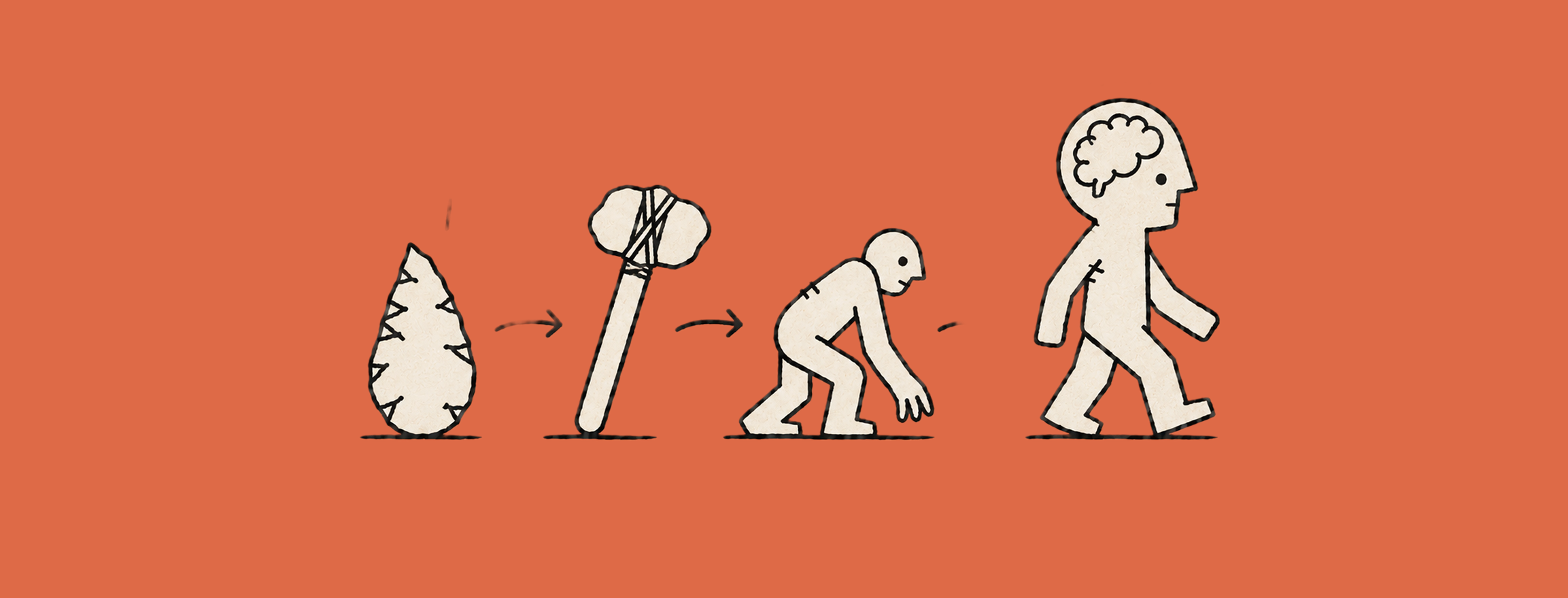
It may not sound like the beginning of everything, but it was. The spine realigned, the pelvis restructured, the weight shifted to balance on two feet rather than four. And then the thing that mattered happened: the hands came free. The same appendages that had carried the body across branches could now hold a stone, explore a texture, feel the weight of a thing and turn it.
Some researchers think the standing was a response to changing climates, a way to cross the open savannah as the forests thinned. Others think it let the small animal scan the horizon for predators or distant food. The cause does not matter as much as the consequence: standing up meant freeing the hands, and freeing the hands set off a cascade of changes that would run, unbroken, from a chipped stone three million years ago to the sentence you are reading now.
And if you want to understand why this is a story about language, you have to hold on to one fact that the rest of this will earn: the most inward, most private, most "natural" thing your mind does, sitting alone with these words and hearing them only on the inside, was once literally impossible. Somebody had to invent the thing that made it possible, and it was not a discovery about how brains work. It was a change in the marks on the page.
We will get there, but first the bones have to speak.
The brain did not come first
Start with the bones, because the bones do not flatter us.
A French scholar named André Leroi-Gourhan, the man who spent decades reading prehistoric tools as frozen sequences of decisions, did something nobody had done with such patience: he read the order of the strikes, the angle of the blows, the plan a hand must have held to turn a stone into an edge. And out of the fossils and the flint he pulled a conclusion that runs dead against the story we tell ourselves.
The hand came free long before the brain grew large. Our ancestors stood up and began walking on two legs, which freed the hands from the ground, and they started gripping and shaping and carrying, at a time when their brains were barely bigger than a chimpanzee's. The little upright creature we call Australopithecus walked the earth more than three million years ago with a brain of four or five hundred cubic centimetres, chimp-sized, and freed hands already at work on the world. The Lomekwi 3 site in Kenya holds stone tools dating back 3.3 million years, made by beings whose skulls could have passed for a chimpanzee's on a shelf.
The swelling of the brain to anything like our own size, three times that, came afterwards, hundreds of thousands and then millions of years afterwards. The hand that could grip and shape a tool was not the product of a big brain; it came first, and the big brain came after, and the order is the whole of the argument.
So the loop runs the other way from the story we tell. The freed hand made tools, and making tools put a pressure on the nervous system that working hands had never put on it before. The brain grew into the demands the hand was already making. Tool and brain came up together, each pulling the other, in a spiral that has no clean beginning where "pure biology" stops and "technology" starts.
There was never a finished human who then, one clever afternoon, invented the chisel. The chisel and the human were being made in the same motion, and we are, from the first stone, technical animals.
If you doubt that the brain was never the secret on its own, look at the animals that got the big brain without the rest. The sperm whale carries the largest brain that has ever existed on this planet, several times the mass of yours, and in the whole long history of that magnificent organ it has built nothing that outlasts the animal that made it. The dolphin is as quick and as socially subtle as almost anything alive, and it has no chisel, no needle, no written line, no tool it improves and hands down and improves again across the generations.
Cleverness, on its own, was never the bottleneck that mattered. What we had that they did not was a hand, lifted off the ground by an upright spine, free to hold a stone and turn it, sitting underneath a face that could shape a sound.
The body is still in the words
People say the hand and the mouth are "doing the same kind of thing," and that is too vague to mean anything. The proof is not in the comparison; the proof is in the actual words you use, right now, every day, without noticing what they are made of.
You say you grasp an idea, reach a conclusion, hold a position, turn a problem over, weigh the evidence, handle a situation, pick up a language, throw out a suggestion, hammer home a point, wrestle with a concept.
Every one of those is a hand word, a thing the hand does to an object in the world, carried over whole into the life of the mind. You did not choose these words because they are decorative; you have no others, and never did. There is no vocabulary for thinking that does not come from the body, because the body is where the vocabulary was made, and thinking grew up inside it.
It goes deeper than the hands, and further than you think. You say you see what someone means, feel that something is true, say a theory smells wrong, hear an echo of an older argument. Every sense organ is in there, lending its operations to the mind, because the mind had no operations of its own to start with and borrowed every one of them from a body that was already at work in the world.
The spatial body is in there too, and you can hear it every time you open your mouth. Volume is high or low, and those are positions in space. A mood is up or down, prices rise and fall, quality is higher or lower, and you look forward to the future and back on the past, both of them directions the body faces. You say something is over your head or beneath you. You say the argument has depth, that the point is superficial, that the analysis goes deeper.
Even the word "understand" is a body word: it is standing under, placing yourself beneath the thing so that it rests on you and you bear its weight. "Comprehend" is seize together, the hands closing around a thing at once. "Concept" is a thing seized, "abstract" is pulled away from, "explain" is make flat, "depend" is hang from.
Peel the Latin and the Greek off any word for a mental act and you will find a hand, a foot, a direction, a posture. The body is not a metaphor for thinking; the body is the material thinking is made of. The words themselves are the fossil record, and they are still readable.
A French philosopher of the body named Maurice Merleau-Ponty, the man who spent his career on the knot between perception and action, put the point with the sharpness it needed: the orator does not think before speaking, nor even while speaking; his speech is his thinking.
You have felt this from inside, and you know the shape of it. You have started a sentence not knowing how it would end and arrived somewhere you did not have in advance, and that was not a lapse in preparation; that is what speaking is. Tie people's hands while they speak and their fluency drops measurably. Let them talk and their hands draw the shape of what they are saying without being asked, tracing the path, sizing the thing, doing part of the thinking in the open.
The hand and the mouth are not doing "the same kind of thing." The mouth is still doing what the hand did, and the words are the proof of it, because they still carry the shape of the hand inside them.
The animal born with nothing
There is an old story that says all this before the bones did, and a philosopher named Bernard Stiegler, the man who built a whole account of the human out of tools and time, spent his career reading it for what it actually says. It is the myth of Prometheus, but the part that matters is the part about his forgetful brother.
In the version Plato tells, two Titans are given the job of handing out qualities to all the living creatures. The brother is Epimetheus, whose name means afterthought, the one who works it out too late. He sets to it generously, dealing out the gifts: to this one strength, to that one speed, to another claws, to another fur against the cold, to another wings.
He is enjoying himself, and he is, true to his name, not keeping count, so that when he reaches the last creature in the line, the human, the bag is empty. Every quality has been given away, and nothing remains. The human is left, in the words of the story, naked, unshod, unbedded, and unarmed. It is to cover this catastrophe that the other brother, Prometheus, forethought, steals fire and technical skill from the gods and presses them into the empty human hand.
Stiegler recognised in this myth what he called the "default of origin": the idea that humans are defined by a lack, an incompleteness that makes technical supplementation a condition of existence from the very start. There was never a "natural" human who later acquired technology; from the beginning, to be human was to be in need of something outside itself. We have no claws, so we knap an edge. We have no fur, so we sew a skin. We have no wings, so we build the aircraft.
The third memory
This is also how a stone tool does something no animal body can do on its own: it remembers, and the kind of remembering it does is new in the history of life.
Think of the two kinds of memory life had before us. There is the memory in the genes, which carries a bird's whole nest-building skill from parent to chick with no lesson given, but which moves only at the crawl of evolution and cannot take in anything an individual learns. And there is the memory in a single nervous system, everything you have learned and felt and figured out, which is supple and fast and dies entirely when you do.
Between those two, for most of life, there is a wall. What an individual works out cannot get into the genes, and what the genes carry cannot learn from a life, and the master's skill dies with the master.
The tool breaks the wall. A well-made hand-axe is a thought that survived the thinker. It holds, in its shape, the solutions to problems of grip and leverage and angle that took countless lives to find, and when a child picks it up the child inherits all of that without a word being spoken, simply by taking hold of the answer. The intelligence is in the object; it is cognition that has climbed out of the body and gone to live in matter, where it can outlast any one of us.
And language is its purest case. A language is the largest hand-axe there is: a vast inheritance of solutions, worn smooth by millions of mouths, that each new child takes hold of and is remade by, without inventing a syllable of it. You did not make the words you are thinking in; you walked into them, the way you walked into a world that was already full of tools, and they have been shaping the inside of your head ever since.
When reading had a voice
Now follow the freed hands forward by a few million years, because the history of reading is the place where you can watch this happen in documents, with dates, instead of having to infer it from bones.
In 397 CE, in Milan, Augustine of Hippo witnessed something that disturbed him enough to record it for posterity. He watched Ambrose, the Bishop of Milan, read a text in complete silence, his eyes scanning the page while his voice remained still. Augustine could not work out how it was possible, and he felt compelled to write it down as though he had seen a man levitate.
His account, in Book VI of his Confessions, deserves the slow walk-through. When Ambrose read, his eyes scanned the page and his heart sought out the meaning, but his voice was silent and his tongue was still. Anyone could approach him freely, so that often, when visitors came, they found him reading like this in silence, for he never read aloud.
Augustine reaches for explanations: perhaps the bishop was afraid that some puzzled listener might ask him to explain a hard passage; perhaps he needed to preserve his voice, which was easily strained. He cannot settle it, because the obvious answer, that reading is just a thing the eyes do quietly on their own, is not available to him. It is not yet thinkable, and that is the whole point.
To see why, you have to see what a page looked like then. The texts of the ancient world were written in what scholars call scriptio continua: an unbroken stream of capital letters, with no spaces between the words, no punctuation, no lowercase, nothing. The opening line of Virgil's great poem ran like this:
ARMAVIRUMQUECANOTROIAEQUIPRIMUSABORIS
That is the wall a reader faced. Your eye cannot take the words, because there are no words yet on the page, only a river of letters that you have to cut into words yourself. The only tool anyone had for finding the joints was the mouth. You sounded it out, aloud or under your breath, and you heard where one word ended and the next began, because your ear could find the boundaries your eye could not.
Reading was a performance, done with the lungs and the tongue, and it was slow, maybe ninety words a minute against the two hundred and fifty or three hundred you are doing right now. Monks spoke of chewing a text, tasting it, digesting it, and they were not being fanciful; for them reading was a thing the body did.
The monks who invented the space
A single small mark changed a species, and the people who made the change were not trying to. The Irish monks of the seventh and eighth centuries were trying to teach Latin to speakers of Old Irish, a language from an entirely different family. On the continent, speakers of Romance languages could half-hear the word boundaries by instinct even in the unbroken stream. The Irish monks had no such luck; Latin reached them as a wall, and they could not hear where the words were.
So they put gaps in, and that small act changed everything. They began, hesitantly at first and then deliberately, to separate the words with spaces. That same line of Virgil became:
ARMA VIRUMQVE CANO TROIAE QVI PRIMVS AB ORIS
It looks like nothing. It is one of the most consequential inventions in the history of the human mind. With the gaps in, the eye can grab a whole word at once by its shape and go straight to the meaning, no voice required. The space between words is the technology that let the voice fall silent.
And once the voice fell silent, everything downstream changed. Reading got fast, two or three times faster, as quick as ours. Reading got private, because a person reading in silence is alone with the text in a way a person reading aloud never is. You could now scan, search, jump, cross-reference, hunt a passage without performing the whole book. The index, the table of contents, the alphabetical list: none of these can even be built on a page with no word boundaries, because you cannot alphabetise a river.
The brain itself rewired under the pressure of the new page. Scans of skilled modern readers show a specific patch of cortex that fires for whole written words as shapes, neural real estate that vocal readers of the unbroken stream did not develop the same way. A typographic convention, invented by foreign monks to solve a teaching problem, reached into the skull and rebuilt the reading brain.
You are reading in an Irish invention, and the naturalness of it is the measure of how completely a technology can disappear into the thing it made.
The body all the way down
The deepest version of this point is mathematics, because maths is the place where people are most sure the body has nothing to do with it. We tell ourselves that maths is the view from nowhere, the one language any mind anywhere would arrive at, pure structure free of any flesh, which is exactly why we bolt it to the side of spacecraft as our message to whoever is out there.
But look at where the numbers actually come from. Two cognitive scientists named George Lakoff and Rafael Núñez traced the whole edifice back to a handful of bodily experiences carried by metaphor: numbers as collections of objects you gather, numbers as lengths you lay end to end, numbers as steps you take along a path. Beyond telling roughly one from two from three, which is about as far as the bare animal goes, every bit of arithmetic is an extension of the body's dealings with stuff. Without the body's experience of walking backwards, we would not have negative numbers. Without the experience of containers, we would not have set theory. Without the experience of object collection, we would not have addition.
You can see the seams at the places maths had to strain past the body. Zero broke every one of the bodily metaphors at once, because you cannot collect no things, or pace out no steps, or measure a length of nothing. The Greeks, for all their genius, had no zero, and when it finally arrived from India by way of the Arab world, the merchants of Florence were so unnerved that the city banned the new numerals in 1299.
Even our most disembodied, most eternal-seeming language is a technology grown out of the flesh. If maths cannot escape the body, nothing can, and nothing ever has. And if nothing can, then there is no language anywhere that floats free of the tools and the hands that made it.
The games change when the tools change
There is a tidy way to say what all of this adds up to, and it comes from Ludwig Wittgenstein, the philosopher who spent his late life arguing that the meaning of a word is the role it plays in a shared, rule-governed activity, a thing he called a language game. Giving an order is one game, telling a joke is another, and reading aloud in a Roman household and reading in silence in a monastery cell are different games too, with different rules, different bodies, different brains behind them.
There is no timeless essence of "reading" that all three are versions of. The equipment makes the act, and changing it changes everything. Change the technical ground and you do not get the same game played on a new surface; you get a new game, and a new kind of player, and over enough time a new kind of mind.
Which means the search for "natural language," the real thing under all the technical layers, is a search for something that was never there. Peel away the writing, the spaces, the alphabet, the grammar shaped by centuries of written analysis, and you do not reach a pure linguistic core at last; you reach nothing that we would recognise as language at all. There was never cooking before the techniques, and there was never language before the technologies.
The screen is rewiring you now
None of this is finished, and that is the part that should make the hair stand up. The move from the printed page to the lit screen is another turn of the same wheel that the monks turned, and the measurements are already in. Eyes on a screen do not move the way eyes on a page move; they skim in a fast lopsided sweep, hunting rather than reading. We are trading some of the long, linear, patient reading mind for a quick, parallel, navigational one, and children raised mostly on screens are growing the second kind of reading brain the way medieval children grew the silent-reading brain their grandparents lacked.
The loop that started with a freed hand and a chipped stone is still running, in real time, through your thumbs.
And it has just reached a place it has never been before. Every technology of language until now exteriorised something we did: the page held our speech, the press copied our writing, the search box held our memory. The machine that now writes does something new in the line; it generates the stuff itself, producing fluent sentences with no person behind them who meant them, working entirely on the cooled residue that all our past speaking left on the page and reaching none of the living act that laid the residue down.
It is the newest tool in the oldest loop. Like every one before it, it will change the user, the way every tool before it has. It will reshape what writing is, and what remembering is, and what it feels like to reach for a word, and "reach" is the right word, because it is a hand word, and the hand was where this started.
There is no natural language
So the flattering story is exactly upside down, and the bones say so. The brain did not come first and reach for tools and words to carry a thought it already had. The freed hand and the working mouth came first, and the tools and the words grew the brain, and they have not stopped growing it.
We are the animal that was issued without a nature and has been making one ever since out of the things it builds. The word "computer" used to mean a person who did sums; a machine took the word and the job both. The @ in your email address spent centuries as a dusty merchant's mark until a network made it the sign for a place that does not physically exist. The space between these words was somebody's idea, in Ireland, around the year 700. The numerals were somebody else's idea, in India, and they frightened the Florentines enough to be banned.
None of it was found in nature, and all of it was made, and is still being made, and so are we. We are the one that becomes itself through what it makes, that thinks with its hands and remembers in its objects and grows new minds whenever the marks on the page change.
Becoming human is not behind us; it is the thing we are doing right now, with the newest tool already in our hands, reading these words in a silence that two thousand years ago would have looked like a miracle, and feels, to you, like nothing at all.